
Marathon Watch Instructions: A Comprehensive Guide
Marathon watches are renowned for their ruggedness and reliability, favored by military personnel and outdoor enthusiasts alike. This guide provides detailed instructions
for understanding, setting up, utilizing, and maintaining your Marathon timepiece, ensuring optimal performance during any adventure. Explore the world of Marathon!
Understanding Marathon Watches
Marathon watches represent a legacy of precision and durability, initially designed to meet the stringent requirements of the Canadian Department of National Defence. These timepieces aren’t simply accessories; they are tools built for demanding environments. Understanding their core principles is crucial for appreciating their functionality.
Marathon distinguishes itself through a commitment to robust construction, utilizing high-quality materials like stainless steel and sapphire crystal. The brand’s focus on legibility, even in low-light conditions, is evident in its prominent luminous markings. Whether you choose a quartz or automatic movement, each Marathon watch embodies a blend of military heritage and modern engineering.
They are designed to withstand extreme conditions, offering reliability where it matters most. This dedication to performance makes Marathon a trusted choice for professionals and adventurers globally.
History and Military Origins
Marathon Watch’s story is deeply intertwined with military service, beginning in 1973 when the company was selected to provide watches for the Canadian Armed Forces. This wasn’t a random selection; Marathon successfully met rigorous specifications demanding exceptional reliability and durability in harsh conditions. Other military suppliers like Timex, Benrus, and Hamilton also adhered to these standards, but Marathon remains the sole continuing supplier.
The initial contract stipulated specific requirements for water resistance, shock resistance, and legibility. These demands shaped Marathon’s design philosophy, prioritizing functionality over aesthetics. The watches were intended to be dependable tools for soldiers, pilots, and navigators.
This heritage continues today, influencing the design and construction of every Marathon timepiece, solidifying its reputation as a genuine military-grade watch.
Key Features of Marathon Watches
Marathon Watches distinguish themselves through a commitment to robust construction and practical functionality. A core feature is their exceptional durability, engineered to withstand extreme conditions and the rigors of field operations. Quartz models, in particular, are built for resilience. Water resistance is also crucial, though some models require caution regarding prolonged submersion.
Movement choices are significant; Marathon offers both reliable quartz and precise automatic movements. Quartz provides accuracy and low maintenance, while automatic movements appeal to enthusiasts valuing mechanical complexity. Luminousity is paramount, ensuring readability in low-light environments, vital for military applications.
Finally, the secure crown operation and thoughtfully designed rotating bezels contribute to the overall utility and dependability of these timepieces.
Durability and Ruggedness
Marathon Watches are fundamentally built for extreme resilience. Their design prioritizes withstanding harsh environments, making them a favorite among military professionals. This durability stems from high-quality materials and meticulous construction techniques. The cases are typically crafted from robust stainless steel, capable of resisting scratches and impacts.
Beyond the case, components like the crystal – often sapphire – contribute to scratch resistance; Marathon’s commitment extends to internal components, designed to endure shock and vibration. These watches aren’t merely water-resistant; they’re engineered for longevity in demanding situations.
This ruggedness isn’t about aesthetics; it’s about reliability when it matters most, ensuring the watch functions flawlessly under pressure.
Water Resistance Considerations
Marathon Watches boast varying degrees of water resistance, crucial for understanding their limitations. While many models offer substantial protection, it’s not a guarantee against all water exposure. Water resistance is typically measured in atmospheres (ATM) or meters, but these ratings aren’t straightforward depth measurements.
A rating of 50m, for example, doesn’t mean the watch can be submerged to 50 meters; it indicates resistance to splashes and brief immersion. Higher ratings, like 200m or 300m, offer greater protection for swimming or diving, but regular inspection of seals is vital.
Avoid operating the crown underwater, as this compromises the seal. Despite their robustness, Marathon watches aren’t immune to water damage, so cautious use is always recommended.
Quartz vs. Automatic Movements
Marathon Watches utilize both quartz and automatic movements, each offering distinct advantages. Quartz movements are battery-powered, renowned for their accuracy and reliability, requiring minimal maintenance. They are generally more affordable and robust, ideal for demanding conditions. Marathon’s quartz models are engineered for extreme durability.
Automatic movements, conversely, are mechanically powered by the wearer’s wrist motion, eliminating the need for batteries. They represent a traditional watchmaking craft, appreciated for their complexity and elegance. Automatic Marathon watches require periodic servicing to maintain optimal performance.
Choosing between quartz and automatic depends on individual preferences and priorities – accuracy and low maintenance versus mechanical artistry and heritage.
Marathon Watch Models: A Comparison
Marathon offers a diverse range of models catering to various needs. The MSAR Automatic (36mm) is a compact, versatile option, ideal for smaller wrists. The GSAR Automatic (41mm) provides a balanced size and robust construction, a popular all-around choice. For those preferring a larger presence, the CSAR Automatic (46mm) delivers a bold aesthetic and enhanced legibility.
The GPK (General Purpose Kinetic) stands out as a quartz model, prioritizing accuracy and durability. Visual demonstrations highlight the size differences between the SAR watch series – 36mm, 41mm, and 46mm – allowing for informed selection. Marathon consistently combines functionality and durability across its entire lineup.
Each model maintains Marathon’s commitment to military-grade quality and reliability.
MSAR Automatic (36mm)

The MSAR Automatic (36mm) is a highly regarded timepiece, celebrated for its compact size and robust build quality. This model is particularly well-suited for individuals with smaller wrists, offering a comfortable and secure fit. It features a reliable automatic movement, eliminating the need for battery replacements and providing a sweeping seconds hand.
Despite its smaller dimensions, the MSAR doesn’t compromise on durability. It’s engineered to withstand demanding conditions, mirroring Marathon’s commitment to military standards. The watch boasts excellent legibility, even in low-light environments, thanks to its luminous markings. It’s a versatile choice for everyday wear and adventurous pursuits, embodying functionality and resilience.
A true testament to Marathon’s dedication to quality.
GSAR Automatic (41mm)
The GSAR Automatic (41mm) represents a sweet spot in Marathon’s lineup, offering a balance between size and functionality. This model is a popular choice for those seeking a versatile and durable timepiece suitable for a wide range of activities. It features a robust automatic movement, ensuring accuracy and reliability without the need for battery changes.
The GSAR is known for its exceptional legibility, enhanced by its highly luminous markings, making it ideal for use in low-light conditions; Its case is built to withstand harsh environments, reflecting Marathon’s commitment to military-grade durability. The 41mm size provides a comfortable fit for most wrists, making it a practical everyday companion.
A dependable and stylish choice for any adventure.
CSAR Automatic (46mm)
The CSAR Automatic (46mm) is Marathon’s largest and most commanding offering, designed for those who prefer a substantial presence on their wrist. This model boasts the same rugged durability and reliable automatic movement as its smaller counterparts, but with an increased case size for enhanced visibility and a bolder aesthetic.
Built to withstand extreme conditions, the CSAR is a favorite among professionals and adventurers who demand uncompromising performance. Its larger dial provides ample space for luminous markings, ensuring exceptional legibility even in the darkest environments. The robust construction and sapphire crystal offer superior protection against scratches and impacts.
A truly imposing and dependable timepiece for the discerning wearer.
GPK (General Purpose Kinetic)
The GPK (General Purpose Kinetic) represents Marathon’s commitment to providing reliable timekeeping solutions for diverse needs. Engineered for rugged durability, this quartz-powered watch is built to withstand the rigors of field operations and everyday wear. Its design prioritizes functionality and ease of use, making it an ideal choice for those seeking a dependable and low-maintenance timepiece.
The GPK features a robust case, a highly legible dial with luminous markings, and a reliable quartz movement known for its accuracy and longevity. It’s a practical and versatile watch suitable for a wide range of activities, from military applications to outdoor adventures.
A testament to Marathon’s dedication to quality and performance.
Setting Up Your Marathon Watch
Proper setup ensures your Marathon watch functions accurately and reliably. The process differs slightly depending on whether your model is quartz or automatic. Before beginning, familiarize yourself with the crown’s functions – typically, it has multiple positions for winding, setting the time, and date adjustment.

Marathon watches prioritize intuitive operation. Carefully review the specific instructions for your model, as detailed in the accompanying documentation. Understanding the crown’s positions and functions is crucial for accurate time and date setting. Avoid forcing the crown, and always return it to its original position after adjustments to maintain water resistance.
Accurate setup is key to enjoying your Marathon watch’s precision.
Setting the Time (Quartz Models)
Marathon quartz watches are known for their accuracy and ease of use. To set the time, gently pull the crown out to its first position – this is usually indicated by a slight click. Rotating the crown clockwise will move the hour and minute hands forward; counterclockwise will move them backward. Ensure you observe AM/PM correctly if your watch lacks a 24-hour dial.
Pay close attention to the seconds hand to synchronize your Marathon watch with a reliable time source. Once the correct time is set, carefully push the crown back to its original, fully-in position. This ensures a secure seal and maintains the watch’s water resistance. Avoid adjusting the time while the watch is submerged.
Setting the Time (Automatic Models)
Marathon automatic watches, powered by your movement, require a slightly different approach to time setting. Begin by gently pulling the crown out to its second position – typically, this requires a bit more force than with quartz models. Rotate the crown clockwise or counterclockwise to adjust the hour and minute hands to the desired time.
Unlike quartz watches, automatic movements don’t typically “hack” (stop the seconds hand), so precise synchronization can be challenging. However, some Marathon models do feature a hacking mechanism. Once set, carefully push the crown fully back in. Ensure it’s securely seated to maintain water resistance. Remember, automatic watches need regular wear to stay wound and accurate!
Date Adjustment
Adjusting the date on your Marathon watch depends on the model, but generally involves pulling the crown out to the first position. In this position, rotating the crown will change the date. Marathon watches often feature a quick-set date function, allowing for rapid adjustment without rotating the hands through multiple days.
Be cautious when adjusting the date between 9 PM and 3 AM, as this is when the date-changing mechanism is engaged. Attempting to adjust the date during this period could potentially damage the movement. After setting the correct date, ensure the crown is fully pushed back in to maintain water resistance and proper operation. Always double-check the date before fully securing the crown!
Using Marathon Watch Features
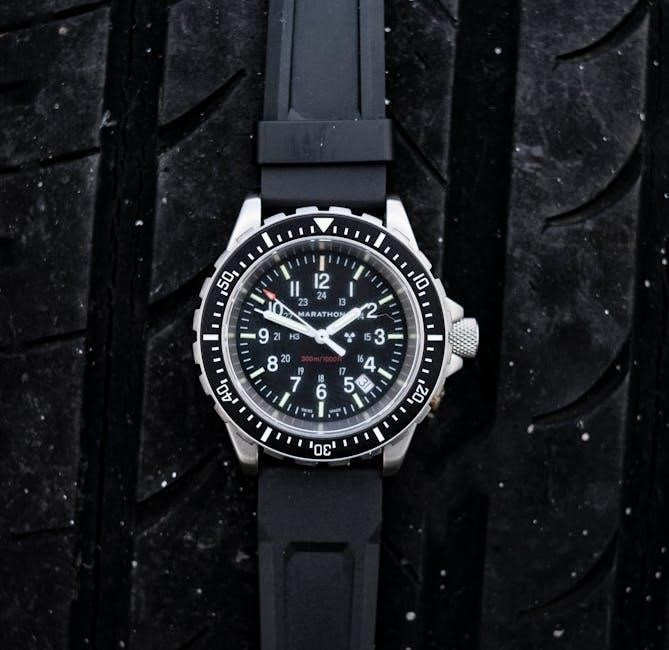
Marathon watches boast several key features designed for practicality and performance. The highly legible luminousity, utilizing tritium tubes, ensures exceptional visibility in low-light conditions, crucial for night operations or running in darkness. Many models include a rotating bezel, often used as a timing mechanism for dives or elapsed time measurements.

Understanding crown operation is vital; typically, screwing down the crown enhances water resistance. Familiarize yourself with your specific model’s crown functions – pulling it out controls time setting and date adjustments. The robust construction and clear design of Marathon watches prioritize functionality, making them reliable tools for any mission or activity.
Luminousity and Night Vision
Marathon watches are celebrated for their exceptional luminousity, achieved through the use of tritium tubes. Unlike traditional luminous paint that requires charging from light, tritium provides a consistent, self-powered glow for up to 25 years. This ensures readability in complete darkness, a critical feature for military applications and nighttime activities.
The tritium tubes illuminate the hour markers and hands, offering a clear and immediate visual reference without impairing night vision. This is a significant advantage over digital displays or watches requiring external light sources. The consistent glow minimizes eye strain and allows for quick time checks in low-light environments, making Marathon watches ideal for demanding situations.
Rotating Bezel Functionality
Marathon watches, particularly the GSAR and CSAR models, feature a unidirectional rotating bezel. This bezel is a crucial tool for timing events, most commonly used as a countdown timer for dives, but adaptable for any time-limited activity. The unidirectional design ensures that the bezel can only be rotated in one direction – counterclockwise – preventing accidental extension of elapsed time, a safety feature vital in critical situations.
To use the bezel, rotate it to align the zero mark with the minute hand. As time passes, the minute hand will indicate elapsed time on the bezel. The clear markings and robust construction allow for precise timing even with gloves on. This functionality enhances the watch’s versatility beyond simple timekeeping.
Crown Operation and Security
Marathon watches utilize a screw-down crown, a key feature contributing to their exceptional water resistance and durability. To operate the crown, unscrew it counterclockwise until it’s fully disengaged. Once unscrewed, you can adjust the time and date functions. Always ensure the crown is fully screwed back down clockwise after adjustments to maintain the watch’s water resistance.
The screw-down mechanism provides an extra layer of security, preventing accidental adjustments and protecting the internal movement from dust and moisture. It’s crucial to apply even pressure when screwing down the crown to avoid cross-threading. Regular inspection of the crown’s seal is recommended to ensure continued protection.
Maintaining Your Marathon Watch
Marathon watches are built for longevity, but proper maintenance is crucial for sustained performance. Regularly clean your watch with a soft cloth and mild soapy water to remove dirt and grime. Avoid harsh chemicals or abrasive cleaners. For quartz models, battery replacement is periodically necessary; seek professional service for this.
Automatic models require less frequent attention, but periodic servicing—every 3-5 years—is recommended to ensure optimal function and lubrication of the movement; Inspect the crown’s seal regularly. If you notice any issues, such as water ingress or inaccurate timekeeping, consult a qualified watch technician for repairs. Proper care will ensure your Marathon watch remains a reliable companion for years to come.
Cleaning and Care
Marathon watches, designed for demanding environments, require consistent cleaning to maintain their integrity. Regularly wipe down the case and bracelet with a soft, damp cloth to remove accumulated dirt, sweat, and debris. For stubborn grime, use a mild soap solution, ensuring thorough rinsing afterward.
Avoid exposing your watch to harsh chemicals, solvents, or extreme temperatures, as these can damage the materials. Pay particular attention to the seals around the crown and case back, ensuring they are free from debris. While Marathon watches are durable, gentle care will preserve their appearance and functionality, extending their lifespan and ensuring reliable performance in any situation.
Battery Replacement (Quartz Models)
Marathon quartz watches require periodic battery replacements to maintain accurate timekeeping. While some users comfortable with watch mechanics may attempt DIY replacement, it’s strongly recommended to have this performed by a qualified watch technician. Improper handling can compromise the watch’s water resistance and potentially damage the movement.
A professional will use the correct tools and techniques to safely open the case, replace the battery with a compatible type, reseal the watch to ensure water tightness, and verify functionality. Ignoring battery replacement can lead to corrosion within the movement, resulting in costly repairs. Regular servicing, including battery changes, is crucial for the longevity of your Marathon quartz watch.
Servicing and Repairs
Marathon watches are built for durability, but even the most robust timepieces require periodic servicing to ensure optimal performance. Regular check-ups by a qualified watch technician can identify and address minor issues before they escalate into major repairs. Servicing typically involves cleaning, lubrication, and inspection of all components.

For automatic models, a full service every 5-7 years is recommended. Quartz models generally require less frequent servicing, primarily focused on battery replacements and water resistance checks. If you encounter any issues – inaccurate timekeeping, condensation under the crystal, or crown malfunctions – seek professional attention immediately; Attempting complex repairs yourself could void any warranty and potentially cause further damage to your Marathon watch.

Marathon Watch vs. Competitors
Marathon watches frequently draw comparisons to other military-style timepieces like those from Timex and Benrus, both of which historically supplied watches adhering to similar military specifications. However, Marathon currently stands as the sole continuing manufacturer directly fulfilling these requirements, offering a unique legacy of authenticity.
When contrasted with modern smartwatches like the Apple Watch, particularly models designed for running such as the Ultra series, Marathon prioritizes rugged simplicity and long-term reliability over advanced features. While Apple Watches excel in data tracking and connectivity, Marathon watches offer dependable timekeeping and durability without the need for frequent charging or software updates. The choice depends on individual needs – data-driven performance or enduring robustness.
Comparison with Timex Military Watches
Timex, like Marathon, has a long history of providing watches to the military, notably with its General Purpose watches. While Timex military watches offer a cost-effective entry point into the world of field watches, they generally differ in construction and materials compared to Marathon.
Timex often utilizes brass cases and mineral crystal faces, whereas Marathon predominantly employs stainless steel and sapphire crystal, enhancing durability and scratch resistance. Marathon’s focus remains on meeting stringent military specifications, resulting in a more robust and reliable timepiece. Timex models, while dependable, may not withstand the same level of extreme conditions. Ultimately, the choice hinges on budget and the intended level of ruggedness required.
Comparison with Benrus Military Watches
Benrus also holds a significant place in military watch history, having supplied watches during World War II and more recently, re-emerging with modern interpretations of their classic designs. Like Marathon, Benrus prioritizes durability and legibility, but their approach differs in certain aspects.
Historically, Benrus watches featured American-made movements, while Marathon predominantly utilizes Swiss movements, known for their precision and reliability. Modern Benrus watches offer both Swiss and Japanese movements. Marathon consistently adheres to NATO specifications, a key differentiator. Benrus often emphasizes a vintage aesthetic, while Marathon maintains a more utilitarian and modern design. Both brands deliver quality, but Marathon’s unwavering commitment to military standards sets it apart.
Comparison with Apple Watch for Running
Comparing a Marathon watch to an Apple Watch for running presents a contrast between traditional timekeeping and modern technology. The Apple Watch excels in data tracking – pace, heart rate, distance, and even running form metrics – offering detailed post-run analysis; Marathon watches, while lacking these features, provide exceptional reliability and a long battery life, crucial for ultra-marathons or extended outdoor activities.
An Apple Watch requires frequent charging, a potential issue during long runs. Marathon’s quartz models boast years of battery life, and automatics never need batteries. While the Apple Watch offers connectivity and smart features, a Marathon watch is a focused, durable tool, less prone to failure from impacts or water exposure. It’s a choice between comprehensive data and unwavering dependability.