

Novel AI prompting is rapidly evolving, with resources like promptingguide.ai offering updated guides and supporting 13 languages! A new course is available now!
The field focuses on crafting prompts to unlock AI’s potential, moving beyond simple questions to building environments where AI truly understands user needs.
Discover the art and science of creating effective prompts for generative AI, learning to construct, iterate, and validate them for optimal performance and results.
The Rise of Prompt Engineering
Prompt engineering has emerged as a critical discipline alongside the rapid advancement of Large Language Models (LLMs). Initially, interacting with AI felt rudimentary – a simple question eliciting a basic response. However, the realization dawned that the quality of the prompt directly correlates with the quality of the AI’s output.
This realization fueled the rise of prompt engineering, transforming it from an afterthought into a core skill. Resources like promptingguide.ai now offer comprehensive guides, corporate training, and consulting services, demonstrating the growing demand. The field has already surpassed 3 million learners as of January 2024!
The ability to “engineer” prompts – to construct them with clarity, specificity, and strategic techniques like few-shot learning and chain-of-thought prompting – unlocks exponentially more effective AI assistance. It’s no longer about simply asking; it’s about creating the optimal environment for AI to thrive and deliver insightful, relevant results.
Why Novel Prompts Matter
Traditional prompting often yields predictable, sometimes generic, AI responses. Novel prompts, however, push the boundaries of what’s possible, unlocking AI’s creative potential and enabling solutions to complex problems. The current AI landscape demands more than just direct questions; it requires prompts that guide the AI’s “thinking” process.
Techniques like role-playing prompts and utilizing structured output with XML tags allow for nuanced interactions and highly tailored results. Iterative refinement, a cycle of prompt adjustment and validation, is crucial for maximizing AI performance. Resources like promptingguide.ai emphasize this iterative approach.
Ultimately, novel prompts aren’t just about getting an answer; they’re about eliciting the best answer, fostering intuitive understanding, and tapping into the full spectrum of AI’s capabilities. This is especially vital as we navigate the fifth radical transformation in human learning, as some experts suggest.

Core Principles of Effective Prompting
Effective prompting hinges on clarity, specificity, and utilizing examples – a “multishot” approach. Letting the AI “think” through chain-of-thought methods is also key!
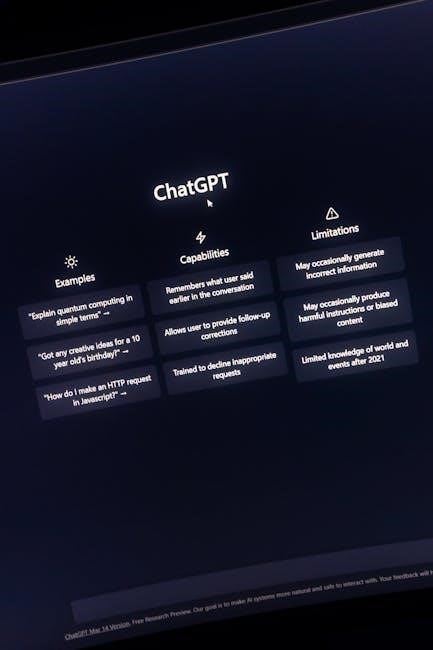
Clarity and Specificity in Prompts
Achieving optimal results with Large Language Models (LLMs) fundamentally relies on the precision of your prompts. Simply put, being clear and direct is paramount. Avoid ambiguity; the more specific you are, the better the AI can understand your intent and deliver a relevant response.
Consider a simple question: “What’s the best time of year to enjoy New England’s fall foliage?” Even this straightforward query demonstrates the power of a well-formed prompt. An AI system, like ChatGPT, will swiftly generate a helpful answer.
However, vague prompts yield unpredictable outcomes. Instead of asking “Tell me about history,” specify “Summarize the key events leading to the French Revolution.” This focused approach guides the AI, ensuring a more accurate and useful output. Remember, the AI interprets your words literally, so precision is crucial for unlocking its full potential.
Utilizing Examples (Few-Shot Prompting)
Few-shot prompting represents a powerful technique for enhancing AI performance by providing the model with illustrative examples directly within the prompt itself. This method guides the AI, demonstrating the desired format and style of the output you expect. Instead of solely relying on instructions, you’re showcasing the solution.
For instance, if you want the AI to translate English to French, you wouldn’t just ask it to translate a sentence. You’d provide a few examples: “English: Hello, French: Bonjour. English: Goodbye, French: Au revoir. English: Thank you…” followed by the sentence you want translated.
This approach is particularly effective when dealing with complex tasks or nuanced requirements. By offering a handful of curated examples, you significantly improve the AI’s ability to understand your expectations and generate high-quality, relevant responses. It’s a key element in prompt engineering.
Chain-of-Thought Prompting for Complex Tasks
Chain-of-Thought (CoT) prompting is a sophisticated technique designed to tackle intricate problems by encouraging the AI to articulate its reasoning process step-by-step. Instead of directly requesting an answer, you prompt the model to “think out loud,” detailing its logic before arriving at a conclusion.
This method is especially valuable for tasks requiring multi-step reasoning, such as mathematical problems or logical deductions. By explicitly requesting the AI to explain its thought process, you gain insight into its decision-making and improve the accuracy of its responses.
For example, instead of asking “What is 123 + 456?”, you’d ask “Let’s think step by step. First…”. This guides the AI to break down the problem, perform the calculations, and present a clear, understandable solution. It’s a crucial skill in effective prompt engineering.

Advanced Prompting Techniques
Advanced techniques include role-playing, utilizing XML tags for structured outputs, and iterative refinement – a cycle of prompt improvement for optimal AI performance.
These methods unlock deeper AI capabilities, moving beyond basic prompts to nuanced interactions and highly tailored results.
Role-Playing Prompts: Giving AI a Persona
Role-playing prompts represent a powerful advanced technique, fundamentally shifting how we interact with AI models. Instead of simply requesting information, you instruct the AI to become someone or something – a historian, a marketing expert, a fictional character, even a specific individual.
This approach dramatically alters the AI’s response style and content. By assigning a persona, you guide the model to draw upon a specific knowledge base, adopt a particular tone, and prioritize relevant information. For example, prompting the AI to respond “as if you are a seasoned travel blogger” will yield a vastly different output than a generic request for travel advice.
The key lies in detailed character descriptions. Specify not just the role, but also their background, expertise, and even their personality quirks. This level of detail helps the AI construct a consistent and believable persona, leading to more nuanced and insightful responses. Experimentation is crucial; refine the persona description iteratively to achieve the desired results. This technique unlocks creative potential and enhances the quality of AI-generated content.
Using XML Tags for Structured Output
XML tags offer a sophisticated method for controlling the format and structure of AI-generated responses. Rather than receiving free-form text, you can instruct the AI to enclose specific data elements within designated tags, creating a machine-readable output. This is particularly valuable when integrating AI responses into applications or databases.
For instance, you might prompt the AI to generate a list of products, requesting each item’s name be enclosed in
This technique demands precise prompt engineering. Clearly define the tags and the data they should contain. While requiring more effort upfront, XML tagging significantly enhances the usability and automation potential of AI-generated content, streamlining workflows and reducing the need for manual post-processing. It’s a powerful tool for structured data extraction.
Iterative Prompt Refinement: A Cycle of Improvement
Prompt engineering isn’t a one-time task; it’s a continuous cycle of refinement. Initial prompts rarely yield perfect results. Expect to iterate – to construct, test, analyze, and revise your prompts repeatedly. This iterative process is crucial for unlocking the full potential of AI models.
Begin with a clear prompt, then carefully evaluate the AI’s response. Identify areas for improvement: is the output too vague? Does it lack specific details? Adjust the prompt accordingly, adding clarity, examples, or constraints. Repeat this process, systematically refining your approach.
Resources like promptingguide.ai emphasize learning how to construct prompts and validate their effectiveness. Embrace experimentation and view each iteration as a learning opportunity. Through consistent refinement, you’ll develop an intuitive understanding of how to elicit the desired responses from AI.

Prompting for Creative Applications
AI excels at creative tasks! Use prompts to generate story ideas, develop characters, and craft compelling dialogue – unlocking new possibilities for writers and artists.
Explore AI’s potential!
Generating Novel Story Ideas with AI
AI is becoming a powerful tool for sparking creativity, particularly in generating novel story ideas. Effective prompt engineering is key to unlocking this potential. Instead of simply asking for “a story idea,” craft prompts that provide context, genre preferences, and even desired themes.
For example, a prompt like “Generate a science fiction story idea involving a sentient AI and a lost colony on a distant planet, focusing on themes of isolation and discovery” will yield far more interesting results than a generic request.
Experiment with different prompt structures, utilizing examples (few-shot prompting) to guide the AI towards your desired style. Consider specifying character archetypes, plot twists, or even the overall tone of the story. Resources like promptingguide.ai offer guidance on constructing effective prompts, helping you refine your approach and consistently generate fresh, inspiring story concepts. The goal is to collaborate with the AI, using it as a brainstorming partner to overcome writer’s block and explore uncharted narrative territories.
AI-Assisted Character Development
AI excels at fleshing out character details, moving beyond basic traits to create truly compelling personalities. Prompt engineering allows you to guide this process, specifying desired character backgrounds, motivations, and flaws. Begin with a core concept – perhaps a disillusioned detective or a brilliant but eccentric scientist – and then use prompts to expand upon it.
For instance, ask the AI to “Develop a backstory for a character who is haunted by a past mistake, detailing their childhood, key relationships, and the event that shaped their current worldview.”
Utilize role-playing prompts, instructing the AI to be the character and answer questions about their life. Resources like promptingguide.ai can help refine your prompts for nuanced results. Experiment with prompts requesting character quirks, internal conflicts, and even dialogue samples. This collaborative approach allows you to build richly detailed characters, adding depth and authenticity to your stories.
Crafting Compelling Dialogue with Prompts
AI can be a powerful tool for generating realistic and engaging dialogue, but effective prompt engineering is crucial. Don’t simply ask for “dialogue”; instead, provide context. Specify the characters involved, their relationship, the setting, and the emotional tone of the scene. A prompt like, “Write a tense exchange between two rivals during a high-stakes poker game,” will yield far better results than a generic request.
Leverage role-playing prompts, asking the AI to write dialogue as a specific character. Experiment with different prompts focusing on subtext, conflict, and character voice. Resources like promptingguide.ai offer guidance on structuring prompts for optimal output.
Iterate on the generated dialogue, refining it to match your vision. Consider prompting the AI to rewrite lines with specific emotional cues or to add layers of meaning. This iterative process, combined with clear and specific prompts, will help you craft dialogue that truly resonates with readers.

Tools and Resources for Prompt Engineering
Promptingguide.ai provides up-to-date guides, while communities and databases offer shared prompts. AI-powered generators assist in creation, and continuous learning keeps skills sharp!
Exploring Prompt Databases and Communities
Leveraging collective intelligence is crucial in the rapidly evolving world of prompt engineering. Numerous online resources are emerging, offering curated collections of effective prompts for various Large Language Models (LLMs). These prompt databases serve as invaluable starting points, showcasing successful strategies and inspiring novel approaches.
Beyond static databases, vibrant online communities are fostering collaboration and knowledge sharing. Platforms dedicated to prompt engineering allow users to exchange ideas, critique prompts, and collectively refine techniques. Participating in these communities provides access to diverse perspectives and accelerates learning.
Resources like promptingguide.ai are central hubs, continually updated with the latest insights. Exploring these platforms allows prompt engineers to stay abreast of cutting-edge methods and discover innovative ways to interact with AI, ultimately maximizing the potential of these powerful tools. The collaborative spirit is key!
Leveraging AI-Powered Prompt Generators
AI-powered prompt generators represent a fascinating evolution in the field, offering a meta-level approach to prompt engineering. These tools utilize LLMs themselves to assist in crafting effective prompts, automating aspects of the process and potentially uncovering novel phrasing.
While not a replacement for human creativity and critical thinking, these generators can be incredibly valuable for brainstorming and overcoming writer’s block. They can suggest alternative wording, explore different prompt structures, and even tailor prompts to specific AI models.
Resources like promptingguide.ai are at the forefront of this development, constantly exploring and integrating new AI-assisted tools. Utilizing these generators alongside traditional methods allows prompt engineers to accelerate their workflow and unlock even greater potential from generative AI. Experimentation is key to mastering this approach!
Staying Updated with the Latest Prompting Techniques
The landscape of AI prompting is incredibly dynamic, with new techniques and best practices emerging constantly. Staying current is crucial for maximizing the effectiveness of your prompts and leveraging the full potential of large language models.
Resources like promptingguide.ai are invaluable for this purpose, offering regularly updated guides and insights into the latest advancements. Engaging with online communities and prompt databases also provides access to a wealth of knowledge and shared experiences.
Furthermore, actively experimenting with different approaches and analyzing the results is essential. The field is evolving rapidly – what works today may not work tomorrow. Continuous learning and adaptation are key to becoming a proficient prompt engineer in this exciting era of AI innovation.

The Future of AI Prompting
AI prompting’s future is bright, especially for India, with its potential in enhancing AI performance. It’s a key skill in this radical learning transformation!
Prompting will become increasingly vital as AI evolves, unlocking exponentially more effective assistance and intuitive understanding.
India’s Potential in Prompt Engineering
India possesses enormous promise within the rapidly expanding field of prompt engineering, a crucial branch of artificial intelligence dedicated to the creation and meticulous refinement of prompts. This focus directly enhances the performance capabilities of AI models, positioning India as a potential global leader.
Several factors contribute to this potential. India’s substantial pool of skilled engineers and a growing tech-savvy population provide a strong foundation. The country’s increasing investment in AI research and development further fuels innovation in prompt engineering techniques.
Furthermore, India’s diverse linguistic landscape offers a unique advantage in developing prompts that cater to a wider range of languages – a capability already demonstrated by promptingguide.ai’s support for 13 languages. This multilingual expertise is invaluable in creating inclusive and globally relevant AI solutions. The nation is poised to contribute significantly to the evolving landscape of AI learning and application.
The Evolving Landscape of AI Learning
We are currently experiencing the fifth and most radical transformation in human learning, a period marked by the rise of artificial intelligence and its capacity to augment our cognitive abilities. However, a staggering 99.9% of the population remains unaware of the profound implications of this shift.
The key to unlocking truly intelligent AI lies not solely in asking the right questions, but in cultivating the optimal environment for those inquiries to flourish. This necessitates a deeper understanding of prompt engineering – the art and science of crafting effective prompts.
Resources like promptingguide.ai are vital in navigating this evolving landscape, offering updated guides and fostering a community dedicated to mastering these techniques. The future of AI learning hinges on our ability to adapt and embrace these new methodologies, ensuring AI becomes a truly intuitive and effective tool for all.

Prompting as a Key Skill in the AI Era
As AI tools become increasingly integrated into our daily lives, the ability to effectively communicate with them will be paramount. This is where prompt engineering emerges as a crucial skill, bridging the gap between human intention and AI execution. No longer is it sufficient to simply ask a question; crafting precise and nuanced prompts is essential.
Resources like promptingguide.ai are dedicated to equipping individuals with the knowledge and techniques needed to excel in this new domain. From clarity and specificity to utilizing examples and chain-of-thought prompting, mastering these skills unlocks the full potential of AI.
In the AI era, prompt engineering isn’t just a technical skill; it’s a fundamental literacy, empowering users to harness the power of AI for innovation, problem-solving, and creative expression. It’s a skill for everyone.